
Stigma attached to mental health. - One Conversation Could Change Mental Health Forever
What if the biggest barrier to mental wellness isn't in our minds—but in our conversations?
The Conversation That Never Happens
Picture this: Your colleague mentions they're taking a day off for a dentist appointment. No one blinks. Another colleague says they're seeing a therapist. Suddenly, the room gets quiet, eyes dart away, and the subject quickly changes.
Why do we treat a broken tooth differently than a broken heart? The answer lies in one of humanity's most persistent and dangerous myths: that mental health struggles are somehow different, shameful, or a sign of weakness.
The Weight of Invisible Chains
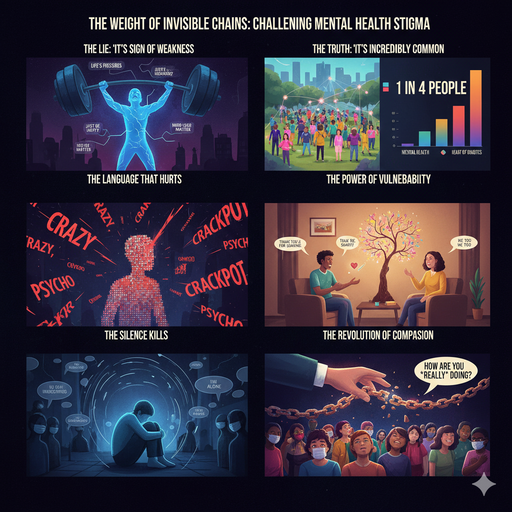
Mental health stigma isn't just uncomfortable—it's literally life-threatening. Studies show that stigma prevents 60% of people with mental health conditions from seeking help. It's like building hospitals but convincing people they're not allowed to use them.
The cruel irony? Mental health challenges are as common as the weather. 1 in 4 people will experience a mental health condition in their lifetime. That means if you're reading this in a room with three other people, statistically, one of you is struggling right now—and probably suffering in silence.
The Myths We Keep Feeding
Let's demolish some of the most toxic myths that keep stigma alive:
Myth: "Mental health issues are rare and abnormal"
Reality: They're incredibly common. Depression affects more people annually than diabetes. Anxiety disorders are more prevalent than heart disease.
Myth: "People with mental health conditions are dangerous"
Reality: They're far more likely to be victims of violence than perpetrators. The overwhelming majority pose no risk to anyone except, tragically, sometimes themselves.
Myth: "Mental health problems are a sign of weakness"
Reality: Often, it's the strongest people who break first because they've been carrying too much for too long without support.
Myth: "Therapy is for people who can't handle life"
Reality: Therapy is for people smart enough to use professional help to handle life better.
The Language That Hurts
Words matter more than we realize. When we say someone is "crazy," "psycho," or "mental," we're not just being casual—we're reinforcing the idea that mental health struggles make someone less human, less worthy of respect and care.
Every time we use mental health terms as insults, we send a message to those struggling: "Your pain is a punchline. Your experience is something to be ashamed of."
The Ripple Effect of Silence
Stigma creates a devastating chain reaction. When people hide their struggles, others assume they're alone in theirs. This isolation breeds more shame, more silence, more suffering. It's a collective lie we all participate in: pretending we're all fine when none of us are fine all the time.
The teenager who thinks they're the only one feeling suicidal. The executive hiding panic attacks in bathroom stalls. The new mother drowning in postpartum depression but afraid to "admit failure." All suffering alone because we've made mental health struggles unspeakable.
The Revolution Starts With You
Here's the beautiful truth: you have the power to change this. Not through grand gestures or policy changes (though those help), but through simple, brave conversations.
Share your story (when you're ready). Your vulnerability gives others permission to be human too.
Use precise language. Instead of "I'm so OCD," try "I like things organized." Instead of "that's crazy," try "that's surprising."
Listen without fixing. When someone shares their struggle, resist the urge to offer solutions. Sometimes, being heard is the healing.
Normalize therapy. Talk about your therapist the way you talk about your dentist—as a professional who helps maintain your health.
Check in authentically. Instead of "How are you?" try "How are you really doing?" and mean it.
The Companies Leading the Change
Progressive organizations are realizing that mental health stigma isn't just morally wrong—it's bad business. Companies with strong mental health support see reduced absenteeism, higher productivity, and better employee retention.
Some are offering mental health days, therapy coverage, and mindfulness programs. Others are training managers to recognize signs of struggle and respond with compassion rather than judgment.
The Celebrity Effect
When public figures like Simone Biles, Prince William, or Dwayne Johnson share their mental health journeys, they don't just inspire—they normalize. They show that strength includes asking for help, that success doesn't immunize against struggle, and that seeking support is courageous, not weak.
Your Next Small, Brave Step
You don't need to become a mental health advocate overnight. Start small:
Share an article about mental health on social media
Ask a friend how they're really doing
Use your employee assistance program if you have one
Correct someone who uses mental health terms as insults
Talk openly about your own therapy or counseling
Each small action creates ripples. Those ripples become waves. Those waves become the revolution.
The World We're Building
Imagine a world where:
Therapy appointments are as normal as gym sessions
Mental health days are standard workplace policy
Children learn emotional intelligence alongside math and reading
Asking for help is seen as wisdom, not weakness
No one suffers alone in silence
This isn't a fantasy. It's the world we're already building, one conversation at a time.
The Truth About Courage
The most courageous thing you can do isn't to suffer in silence. It's to speak your truth, seek help when you need it, and show others that it's safe to be human.
Your mental health matters. Your struggles are valid. Your healing journey deserves support, not shame.
The revolution against mental health stigma doesn't start with governments or organizations. It starts with you, choosing to be brave enough to be real.
One conversation can't change the world—but it can change someone's world. And that's how revolutions really begin.
